
In Pakistan, the national debate on education often focuses on policy-level reforms and budget constraints. However, the real story unfolds in classrooms and schools, where administrators work to resolve the issues faced by students and teachers.
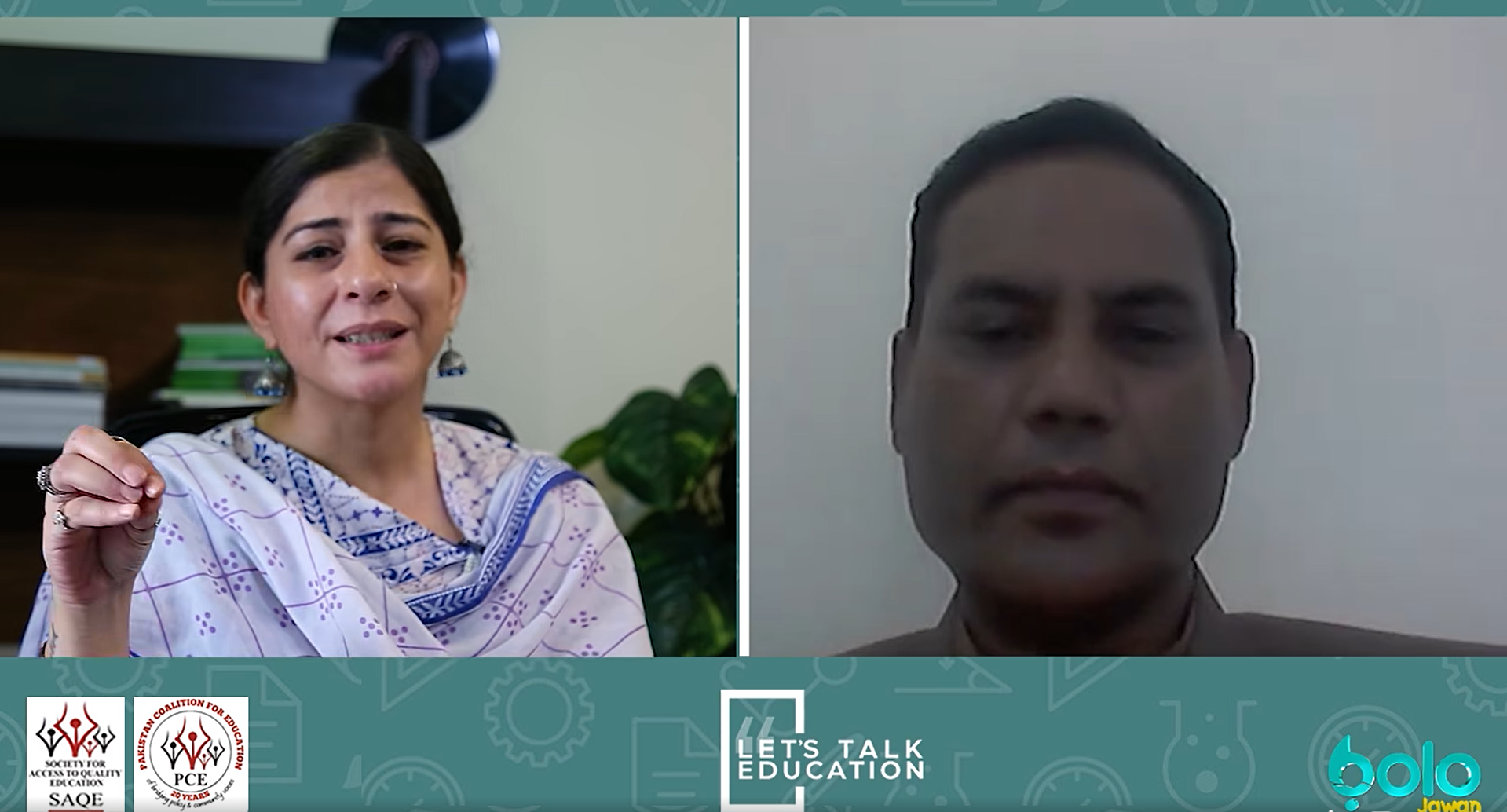
Season 4 Episode 6 of Let’s Talk Education, produced in collaboration with the Society for Access to Quality Education (SAQE) and Bolo Jawan, features a conversation between host Areebah Shahid and Rao Abdul Karim, CEO of the District Education Authority Faisalabad. The discussion focused on leadership and innovation in education at the district level.
From Struggle to Leadership
The episode opens with Rao Abdul Karim sharing his personal struggle. As a young boy, he walked eight kilometers every day to attend school in his village. Today, as CEO of the District Education Authority Faisalabad, that same experience gives him a rare empathy for children who face barriers to learning, whether it is distance, poverty, or social constraints. He reflected, “Every stage of my career was about persistence, and about learning from people around me.” This mindset continues to guide his leadership, where understanding people, including teachers, parents, and students, remains central to improving education at the district level.
Innovation and Inclusivity in Action
While talking about the need for greater innovation and inclusivity, Mr. Abdul Rao Karim talked about the establishment of transgender schools in Punjab. Over 30 schools in Faisalabad alone provide safe spaces and learning opportunities to one of the most marginalized communities. According to the 2017 Population and Housing Census, Pakistan recorded 21,774 transgender persons. Although, advocacy groups believe the actual number is significantly higher (Pakistan Bureau of Statistics, 2017). Despite this, access to education remains extremely limited, with only about 30% of transgender individuals reaching primary level and 7% making it to university (Inter-agency Network for Education in Emergencies [INEE], 2022). These statistics underscore the urgent need for dedicated schools that ensure no child is denied the right to learn due to their identity. “On my first visit to a transgender school, I was amazed at the enthusiasm. These are not just schools, they are spaces of opportunity,” he shared.
The second initiative is the introduction of Early Morning Schools for working children. In many communities, poverty forces children into labor at an early age, leaving them with little or no opportunity to attend regular schools. To address this reality, Early Morning Schools operate from 7:30 to 10:30 a.m., enabling children who dropped out due to poverty and need to work to support their families to study before heading to their jobs. Supported by international partners such as JICA, these accelerated programs provide a chance, helping child workers and school dropouts reconnect with education and envision a brighter future.
Classrooms as the True Frontline
The real struggles and solutions in education unfold inside classrooms, where children arrive with different strengths, challenges, and circumstances. As Abdul Karim noted, “Every classroom is a world of its own,” and it is within this diversity that the future of learning is shaped. Reflecting on the changes he hopes to see, he remarked that if he had a magic wand, he would transform classroom environments and train teachers to understand every child as unique. His vision moves beyond administrative reform, emphasizing empathy and individualized learning as the foundation for real educational change.
Areebah Shahid concludes her conversation with Rao Abdul Karim by mentioning, “We often think change is a top-down approach. But sustainable change always begins from the classroom, the grassroots of education.”
Let’s Talk Education Season 4, Episode 6, produced in collaboration with SAQE and PYCA, is a reminder that if we want to change education in Pakistan, we must begin where learning truly takes place – in the classroom.
Watch the full episode now!


